

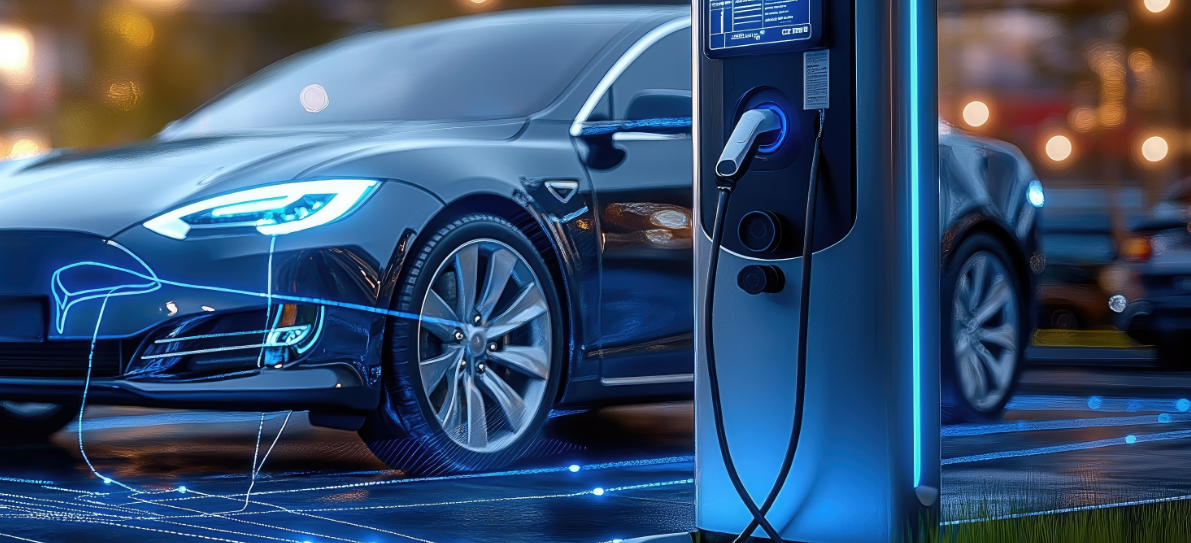
Charging is an important part of owning an electric vehicle, but the different connectors, charger types and charging speeds can make it seem more complicated than it is.
Once you understand a few basics, it becomes much easier to work out where you can charge an EV, how long it might take and what you should check before choosing one.
This guide covers the essentials for UK drivers, including home and public charging, common connectors and key considerations when buying an electric vehicle.
How Does Electric Vehicle Charging Work?
An electric vehicle stores energy in a battery and uses that energy to power an electric motor. To recharge the battery, the vehicle is connected to a suitable chargepoint.
The amount of time this takes depends on several things, including the size of the battery, its current charge level, the power available from the chargepoint and the maximum charging rate the vehicle can accept.¹
AC And DC Charging Explained
There are two main types of EV charging – alternating current (AC) and direct current (DC).
AC charging is commonly used at home, at workplaces and at destinations where a vehicle may be parked for several hours. The car converts the AC electricity into DC electricity before storing it in the battery.
DC charging works differently. The conversion takes place at the chargepoint, allowing electricity to be supplied directly to the vehicle’s battery. DC is commonly associated with higher-powered rapid and ultra-rapid public charging.¹
Battery Capacity And kWh
Two abbreviations appear regularly when looking at electric vehicles: kW and kWh.
A kilowatt (kW) measures power, so it is commonly used to describe how quickly a charger can supply energy or how much charging power a vehicle can accept.
A kilowatt-hour (kWh) measures energy. In simple terms, an EV battery with a higher kWh capacity can store more energy.
The distinction is useful when comparing vehicles. Battery capacity can affect how far an electric vehicle can travel between charges, while its charging rate affects how quickly that energy can be put back into the battery.
Where Can You Charge An Electric Vehicle?
One of the first things to consider before buying an EV is where you will normally charge it. For many drivers this will be at home, but public, workplace and destination charging can also form part of a regular routine.
Charging At Home
Drivers with suitable off-street parking may be able to have a dedicated EV chargepoint installed at home.
Home charging can be convenient because the vehicle can be connected while it is parked overnight or for another extended period. Rather than waiting for the battery to become nearly empty, many owners simply top it up when the car is not being used.
Whether a home chargepoint can be installed will depend on the property, parking arrangements and electrical installation, so professional advice may be required.
Public EV Charging
Public chargepoints are available in locations such as motorway service areas, dedicated charging hubs, car parks and other destinations.
The way you access and pay for public charging can vary between operators and chargepoints. UK regulations require contactless payment at certain public chargepoints, while operators may also provide other payment methods such as apps.²
Before setting off on a longer journey, it can be useful to check where suitable chargers are located and whether they are compatible with your vehicle.
Workplace And Destination Charging
Some employers provide EV charging for staff, while chargers can also be found at destinations such as hotels, leisure facilities and shopping centres.
These chargers can be useful because the vehicle is already going to be parked for a period of time. Depending on the location and charging speed, this may provide a useful top-up rather than requiring a separate charging stop.
What Are The Different EV Charging Speeds?
EV chargers can provide very different amounts of power, measured in kilowatts (kW).
From 2026, the Department for Transport uses four power bands in its public EV charging statistics: standard, standard plus, rapid and ultra-rapid. The older terms “slow” and “fast” may still be used elsewhere in the charging industry.³
Standard Charging
Standard chargers are rated from 3kW to less than 8kW in current Department for Transport statistics. They are typically associated with longer stays, such as daytime or overnight charging.³
Home charging is a common example. A driver may not need the battery to recharge quickly if the car is connected in the evening and will not be needed again until the following morning.
Standard Plus Charging
Standard plus covers chargers rated from 8kW to less than 50kW in current Department for Transport statistics. These are typically suited to medium-length stays, such as a shopping or leisure trip.³
It is important to remember that the charger’s advertised output is only one part of the equation. The vehicle must also be capable of accepting that charging rate.
For example, connecting a car with a lower maximum AC charging rate to a higher-powered AC chargepoint will not make the vehicle charge at the full output advertised by the charger.³
Rapid And Ultra-Rapid Charging
The Department for Transport currently classifies chargers from 50kW to less than 150kW as rapid, while chargers rated at 150kW and above are classed as ultra-rapid.³
These chargers can be particularly useful during longer journeys when drivers want to add a useful amount of charge without stopping for several hours.
Again, a high charger output does not mean every electric vehicle connected to it will charge at that speed. A vehicle’s own maximum AC or DC charging capability can limit the power it receives.³
Which EV Charging Connector Do You Need?
Not every electric vehicle uses exactly the same charging connection, particularly when comparing newer cars with older models.
Checking connector compatibility is therefore an important part of choosing an EV.
Type 2
Type 2 is widely used for AC charging in the UK. UK charging regulations require Type 2 connectors on normal and high-power AC public charging points.⁴
It is commonly associated with home and destination charging and also forms part of the CCS Combo 2 connection used for DC charging.
CCS
CCS, or Combined Charging System, is widely used for DC rapid charging on modern electric vehicles.
The CCS Combo 2 connection combines the Type 2 design with additional connections that allow compatible vehicles to accept DC charging.
UK regulations require high-power DC public charging points to be fitted with a CCS Combo 2 connector.⁴
If you are considering an EV for frequent longer journeys, checking its maximum CCS charging rate can help you understand what to expect when using rapid public chargers.
CHAdeMO
CHAdeMO is another DC rapid-charging connector and can be found on some electric vehicles, including a number of older models.
CCS Combo 2 has held a stronger position than CHAdeMO in the UK market since 2017, so someone considering an older used electric vehicle with a CHAdeMO connection should check whether suitable public chargers are convenient for their regular journeys.⁴
What About Older Electric Vehicles?
Connector type can become particularly important when buying an older EV.
Some earlier electric vehicles use CHAdeMO for DC charging rather than CCS. This does not necessarily prevent the vehicle from being practical, but it makes checking local and regularly used charging infrastructure more important.
Rather than assuming that every EV can connect to every public charger, check the specifications of the individual model you are considering.
How Long Does It Take To Charge An Electric Vehicle?
There is no single answer to how long an electric vehicle takes to charge.
Charging time can be affected by:
- the battery’s capacity
- how much charge is already in the battery
- the output of the chargepoint
- the maximum AC or DC charging rate supported by the vehicle
- battery conditions
- the vehicle’s battery management system and charging characteristics
Current Department for Transport guidance makes clear that the power rating of a charger does not guarantee that an EV will receive that full amount of power. The vehicle’s charging capability, its battery management system and other factors can reduce the rate delivered.³
Charging speed is not necessarily constant from the moment the vehicle is plugged in until the battery is full. Many EVs charge more slowly as the battery becomes fuller, particularly during rapid charging.⁵
This is one reason charging times are often discussed over a partial charge rather than from completely empty to completely full. Current Department for Transport statistics, for example, use typical charging times from 20% to 80% when comparing charger power bands.³
When comparing electric vehicles, look at the charging performance of the specific model and battery version rather than assuming that two cars connected to the same charger will take the same amount of time.
What Should You Consider Before Buying An EV?
Charging specifications can look technical, but a few practical questions can help you decide whether a particular electric vehicle suits your needs.
If you’re still deciding which type of EV could work for you, you can also explore some of the popular electric vehicles available through Copart UK.
Can You Charge At Home?
Think about where the vehicle will spend most nights and whether you have access to suitable off-street parking.
Being able to charge at home can make EV ownership convenient, but it is not the only option. If you cannot install a home chargepoint, look at the public or workplace charging available near you and along your regular routes.
Consider how often you would realistically need to charge and whether those locations fit your normal routine.
Check The Vehicle’s Charging Capability
Before choosing an EV, check the specifications of the individual model and version.
Useful information includes:
- battery capacity
- AC charging capability
- DC rapid-charging capability
- connector type
- charging cables or equipment supplied with the vehicle, where applicable
Two versions of the same model can sometimes have different battery or charging specifications, so it is worth checking the individual vehicle rather than relying on general information about the model.
Think About Your Normal Journeys
The biggest possible battery or fastest possible charging rate is not automatically necessary for every driver.
Think about how far you normally travel in a day, how frequently you make longer journeys and where the car is parked between trips.
A driver covering relatively short daily distances may have very different charging needs from someone who regularly makes long motorway journeys.
Looking at your actual driving habits can make it easier to decide what battery capacity, range and charging performance you really need.
Consider Battery Condition
Battery condition is another factor when looking at a used electric vehicle. As an EV battery ages, its usable capacity can change, which may affect the distance the vehicle can travel between charges.
Where available, information about battery health can therefore provide useful additional context when considering an EV.
Copart UK offers free, independent EV Battery Health Reports on selected electric vehicles for active Members. Powered by AVILOO Battery Diagnostic, these reports can include the battery’s State of Health, voltage performance, a Battery Control Unit health check, battery-to-vehicle communication information and charging insights.
Charging An Electric Vehicle – What First-Time Owners Should Know
If you are considering your first EV, you do not need to become an expert on every charger or connector.
Start by working out where you would normally charge. Then check which connection the vehicle uses, how quickly it can charge and whether its battery capacity and usable range are suitable for your typical journeys.
Remember that the maximum power shown on a public charger does not guarantee that your vehicle will accept that full charging rate.³
If you’re looking at an older electric vehicle, take particular care to check connector compatibility and charging performance. Also consider what information is available about the condition of the battery.
These checks can give you a much clearer idea of how an EV could fit into everyday use before you make a purchase.
Finding Electric Vehicles With Copart UK
If you understand your charging requirements before starting your vehicle search, it becomes easier to identify electric vehicles that may suit them.
When viewing an EV through Copart UK, read the individual Lot Details and available vehicle information carefully. Check the exact model and version, and carry out your own research into its battery capacity, connector type and charging capability where needed.
Where an EV Battery Health Report is available, Copart recommends reviewing it alongside the vehicle images, description, documents and other Lot Details as one part of your own checks before bidding.
You can search electric vehicles currently available through Copart UK to see what is currently available in our auctions.
Electric Vehicle Charging FAQs
Can I Charge An Electric Vehicle At Home?
Many electric vehicle owners with suitable off-street parking use a dedicated home chargepoint. Whether one can be installed at your property will depend on factors including your parking arrangements and electrical installation.
How Long Does An EV Take To Charge?
There is no fixed charging time for every EV. It depends on factors including battery capacity, current charge level, charger output and the vehicle’s maximum charging rate.¹ ³
Can Every Electric Car Use Every Public Charger?
No. Connector compatibility and the charging capabilities of the vehicle need to be considered. Type 2 is widely used for AC charging, while CCS Combo 2 is required on high-power DC public charging points under UK regulations.⁴
What Is The Difference Between Type 2 And CCS?
Type 2 is used for AC charging. CCS Combo 2 uses the Type 2 design with additional connections that allow a compatible vehicle to receive DC charging.⁴
Can You Own An EV Without A Home Charger?
Yes, but you should consider your charging routine carefully before buying. Look at suitable public, workplace or destination chargers near your home and along your regular routes, and consider how often you are likely to need them.
What Should I Check Before Buying A Used Electric Vehicle?
Check the vehicle’s battery capacity, connector type and AC and DC charging capabilities, along with the charging equipment included where applicable. You should also consider battery condition, expected usable range and whether suitable charging is available for your normal journeys.
Understanding electric vehicle charging before you start looking for an EV can make it much easier to compare your options. Check where you are likely to charge, what connectors and charging speeds a vehicle supports and whether its battery and range suit your everyday driving. When you’re ready to explore what’s available, search electric vehicles currently available through Copart UK.
Sources
¹ Competition and Markets Authority, Electric Vehicle Charging Market Study – Final Report.
² Office for Product Safety and Standards and Office for Zero Emission Vehicles, Regulations: Public Charge Points.
https://www.gov.uk/guidance/regulations-public-charge-points
³ Department for Transport, Electric Vehicle Charging Infrastructure Statistics: Frequently Asked Questions, updated 21 May 2026.
⁴ Department for Transport, Alternative Fuels Infrastructure Regulations (AFIR) Report 2023.
⁵ RAC, How Long Does It Take to Charge an Electric Car? Charging Speeds Explained.
https://www.rac.co.uk/drive/electric-cars/charging/electric-car-charging-speeds/